

It used to be, if someone had a complaint about a business, they’d have little recourse.
Sure, they could go to the Better Business Bureau and lodge a complaint. Some TV stations and newspapers had consumer advocates who would shame companies into doing the right thing.
But unless you were one of the lucky ones whose complaint got some airtime or ink, you would be lucky to be able to spread the word beyond your immediate circle of friends.
For the consumer, the age of instant information – Twitter, Facebook, blogs, YouTube, et al – is a boon. After unsuccessfully trying to get United Airlines to replace the guitar their baggage handlers smashed, Dave Carroll even got a career boost out of the videos he posted to YouTube that became a viral sensation.
At BlogWorld Expo in New York last month, more than one panel discussed the phenomenon of people complaining publicly on Twitter and Facebook before even reaching out to customer service. Fact is, it’s easier. And, frankly, anyone who’s ever dealt with customer service for a large company probably thinks they’ll get a response faster that way than if they went through regular channels.
A friend of mine, Rich Becker, had a problem with a charge from Budget Car Rental and tried to go through relatively traditional channels first. He’s a public relations and marketing professional and knew that taking to the Internet first was the equivalent of going nuclear, so he tried to resolve his issues amicably. But it wasn’t until he did start tweeting about the problem that anyone from Budget got on the ball and tried to take care of things.
Fact is, if your business is not active online and isn’t continually monitoring brand mentions, you can find your (hopefully good) name smeared almost beyond repair. It was with that in mind that I read this infographic from our friends at ZenDesk on how to recover from a customer service fiasco online:
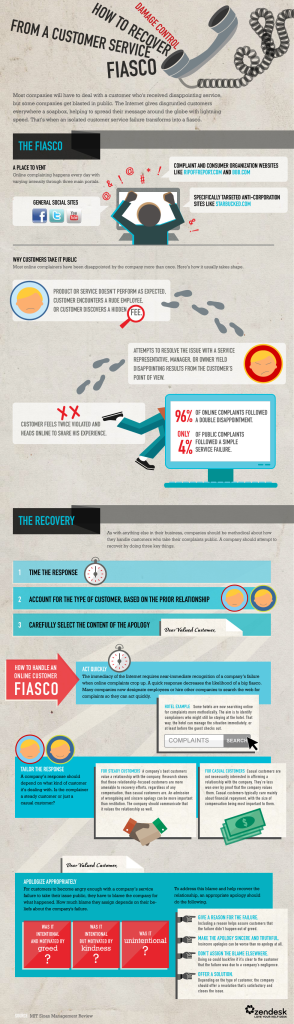
How about you? What are your experiences with online customer service, either as a consumer or as a business?
Heart image used under Creative Commons license, by AngelaArcher.com on Flickr


Great article! I had a business contact me, just the other day, after they received a negative customer review online. I had been attempting to nudge this traditional business to develop a social media program. Of course, at the time, they didn’t see the need. So, without a presence online, where do you think the first complaint went? Yes, straight to the top of search engines. Needless to say, I have been given a budget to develop their program.
Thanks, James – glad they saw the error of their ways, albeit belatedly.
I don’t even bother to call customer service anymore I simply post my problem on twitter and I will get a message within minutes why wait on hold?
@Kevin – While I partially agree with you, there’s also the point that sometimes people (and companies) just make mistakes. And some will resolve things quickly without a public intervention. On Twitter, it’s public immediately – no opportunity for the store or brand or whomever to fix the problem.
Trust me, I’m no shrinking flower when it comes to complaining (just ask my husband!), but I also believe that people should be given the opportunity to fix things before I tell the world they screwed up. When they don’t? Well, then, that’s a whole ‘nother story.
Interesting information. Thanks for sharing it here.
Keep posting more like this.
http://blog.hudsonhorizons.com/Article/Why-Twitter-is-your-Next-Customer-Service-Star.htm – Totally agree! To leverage Twitter as a customer service platform is only smart business and proactive customer care. Awesome infographic too!
Thanks Amy,
Budget was such a terrible experience, taking almost a full month to completely resolve the issue. And you’re right, they gave me no other recourse other than public discourse, and even then they only responded to quiet my complaint (not to provide a stitch of customer service).
I also might add that the panelists are BlogWorld missed one important point. Unhappy customers only go online because they have a tendency (like water) to pursue the most immediate path (which they got) but it has always been that way (which they neglect).
Before online communication was widely adopted, customers would complain to the first employees they saw. For example, if the gas company raises rates, homeowners would complain to meter readers (on or off the clock) in public or one-on-one.
Most companies are unprepared to handle customer service online. Either that is all the company does, making it a stream of hate, or they try to ignore it (silence it) while filling everyone’s messages with promos. They have a long way to go.
All my best,
Rich
@Shweta & Mary – thanks!
@Rich –
You raise an excellent point. People use the easiest means possible. Heck, I’ve complained to salespeople before. I acknowledge it’s not their fault, generally, but it’s totally natural. They still represent the company and it’s natural to seek them out that way.
The few businesses that have been successful in online customer service are the exceptions and not the rule. The nice thing is that people actually have power to do something about bad service now.
Thanks for your, as always, excellent insights.
Great article! Consumers definitely have more options for making their voice heard, and companies need to be monitoring the web for any mentions of their brand. This means brands need to be more accountable and able to react immediately to consumer complaints.
@CommuniTech – Thanks for your comments. That’s exactly the point I was trying to make.
Great article. I recently had such an experience with a spanish Telco, whilst trying to cancel a contract I had for many years with them. I made +5 calls to customer service without success, they simply hangup twice, following indications I sent 2 faxes asking for canceling the contract … nothing.
.
After that, I decided to use our knowledge, I’m the founder of a social web monitoring company, I new in which sites they use to have presence and started complaining there. It took 12 hours til the contract got canceled.
Francisco
Amazing, Francisco. Good job!
Very interesting article. Maybe this will help a lot of companies to improve on their customer service since it’s easier and fast for people to just complain on Twitter.
@Reginald – Given that so many people already do that, it would behoove most businesses to pay more attention there. Hopefully they will.
This is a topic discussed on many blogs, so it’s surprising that companies haven’t caught onto the importance of cultivating these communities. This article: bit.ly/pJtBNj explains the importance of companies having the guts to ask themselves the ultimate question of how likely the customer is to refer them to another friend.
Great post.
It amazes me that customer service channels are so hard to get results from.
Even using twitter for some mystery shopping feedback reporting gets no results…
A recent flurry of comments to Cafe Rouge in the UK was met with a response 24 hours later with a bland comment…sorry you did not enjoy your visit,please go to this site and fill in the customer feed back form…
Too late…they should have been monitoring activity and got on the case…